We often think of the body as a collection of separate working parts, but in our workshops and daily practice, we treat it like a single piece of joinery. When one joint binds or swells, the stress travels along the grain, pulling on fasteners several feet away. The pelvic floor behaves in this exact way. Formed by layers of striated muscle, connective fascia, and nerve pathways slung across the base of the bony pelvis, this basin supports our internal organs, regulates intra-abdominal pressure, and stabilizes the hips and spine during movement.
When tension settles into this sling of tissue, it rarely announces itself with sharp, localized alarm bells. Instead, it manifests as a stubborn, low-grade ache, a sensation of fullness, shallow breathing, or persistent stiffness in the hips and lower back. In our thirties, years of desk work, athletic impact, and reflexive stress responses accumulate into tissue memory. Rather than forcing these muscles into submission with aggressive stretching or generic exercises, we need to inspect the mechanics, feel where the tension gathers, and release it with the same patient care we bring to shaping dense timber.
Hypertonic Versus Hypotonic States
Before adjusting any system, we must diagnose its current baseline. The fitness world often assumes that pelvic floor trouble stems solely from weakness or laxity, prescribing endless cycles of Kegel contractions. In reality, a tight muscle is not a strong muscle; it is an exhausted muscle stuck in a shortened state. We divide dysfunctional pelvic floor patterns into two distinct mechanical categories: hypertonic, where the tissue holds persistent resting tone and cannot lengthen, and hypotonic, where the tissue lacks baseline resting tension and cannot support load.
Working a hypertonic pelvic floor with strengthening contractions is like trying to tighten a bolt that is already cross-threaded. It increases intra-pelvic pressure, irritates the pudendal nerve, and creates ischemic pain because blood cannot circulate through chronically contracted muscle fibers. The priority for hypertonic tissue is always restoration of excursion: the full, unhurried range between a complete contraction and an unobstructed drop.
| Observable Marker | Hypertonic (High Tone, Restricted) | Hypotonic (Low Tone, Lax) |
|---|---|---|
| Muscular Sensation | Aching, cramping, gripping, tailbone ache | Heaviness, dragging sensation, lack of feedback |
| Bladder Pattern | Urgency, hesitation to start, incomplete emptying | Stress leakage during coughs, jumps, or sneezes |
| Hip and Pelvic Range | Restricted internal hip rotation, tight glutes | Hypermobile joints, instability across pubic bone |
| Breath Mechanics | Chest-dominant breath, ribs held rigid | Abdominal wall distension without elastic recoil |
If you notice pain during deep squats, tailbone soreness after sitting for forty minutes, or a reflexive urge to clench during moments of mental focus, you are likely navigating hypertonicity. In such cases, further tightening must stop immediately. If these sensations accompany persistent pain, burning, or sudden changes in bowel or bladder function, pause your personal assessment and consult a pelvic floor physical therapist who can perform an internal manual evaluation.
The Mechanical Connection Between Jaw and Pelvis
During our early embryonic development, the primitive digestive tract forms with two distinct membranes: the buccopharyngeal membrane at the cranial end, which becomes the mouth and jaw, and the cloacal membrane at the caudal end, which becomes the urinary and reproductive tract. These two poles remain linked throughout adult life through continuous fascial lines and shared neural pathways within the autonomic nervous system.
When the masseter and pterygoid muscles of the jaw clamp shut, the deep pelvic sling mimics the action almost instantly. You can test this physical reflex yourself. Sit upright on an unpadded wooden stool. Clench your molars together with moderate force and notice what happens to your perineum. You will feel an involuntary upward lift, a quiet bracing across the sit bones. When you release the jaw, letting the teeth separate by three millimeters and allowing the tongue to drop from the palate, the base of the pelvis yields in response.
We see this connection show up continually in people who spend their days concentrating behind screens or lifting heavy loads. Treating pelvic tension therefore begins at the skull. Releasing the temperomandibular joint creates an immediate neurological permission slip for the lower diaphragm to expand. If the mouth holds grit, the pelvic floor will keep its guard up.
Diaphragmatic Breathing for Pelvic Drops
The respiratory diaphragm and the pelvic floor operate as an antagonistic pair, like two pistons moving in tandem within a cylinder. When you inhale, the dome of the respiratory diaphragm contracts and flattens downward, compressing the abdominal contents. To accommodate this displaced volume, the pelvic floor must soften, widen, and drop downward. When you exhale, the respiratory diaphragm returns upward to its rested dome shape, and the pelvic floor gently recoils without any voluntary effort.
When stress keeps us in short, shallow chest breathing, the pelvic floor loses this natural downward excursion. Over eight to ten thousand breaths per day, the tissues adapt to this reduced range and freeze in an elevated posture. We use the pelvic drop exercise to restore that fluid range of motion through focused breath mechanics.
Executing the Pelvic Drop
- Lie supine on a firm wool rug or mat with your knees bent at a ninety-degree angle and your feet flat on the floor, roughly hip-width apart. Place your hands lightly across your lower ribs.
- Exhale completely through open lips, feeling the ribs sink toward the spine. Pause for two quiet seconds at the bottom of the breath.
- Inhale through your nose over a count of four seconds. Direct the air low and wide, imagining your pelvis as an earthen bowl filling with water. Do not push your belly out with muscular force; let the incoming air expand the lower abdomen, flanks, and lower back simultaneously.
- As the breath reaches the bottom of the torso, focus your attention on the space between your sit bones, your pubic bone, and your tailbone. Visualize these four bony points drifting apart from one another by a fraction of an inch, creating an open diamond shape.
- Exhale naturally through your nose without squeezing or pulling the muscles inward. Allow the recoil to happen passively, like a piece of elastic gently returning to its resting length.
- Repeat this sequence for twenty unhurried breath cycles, twice each day.
Gentle Mobilization Over a Firm Bolster
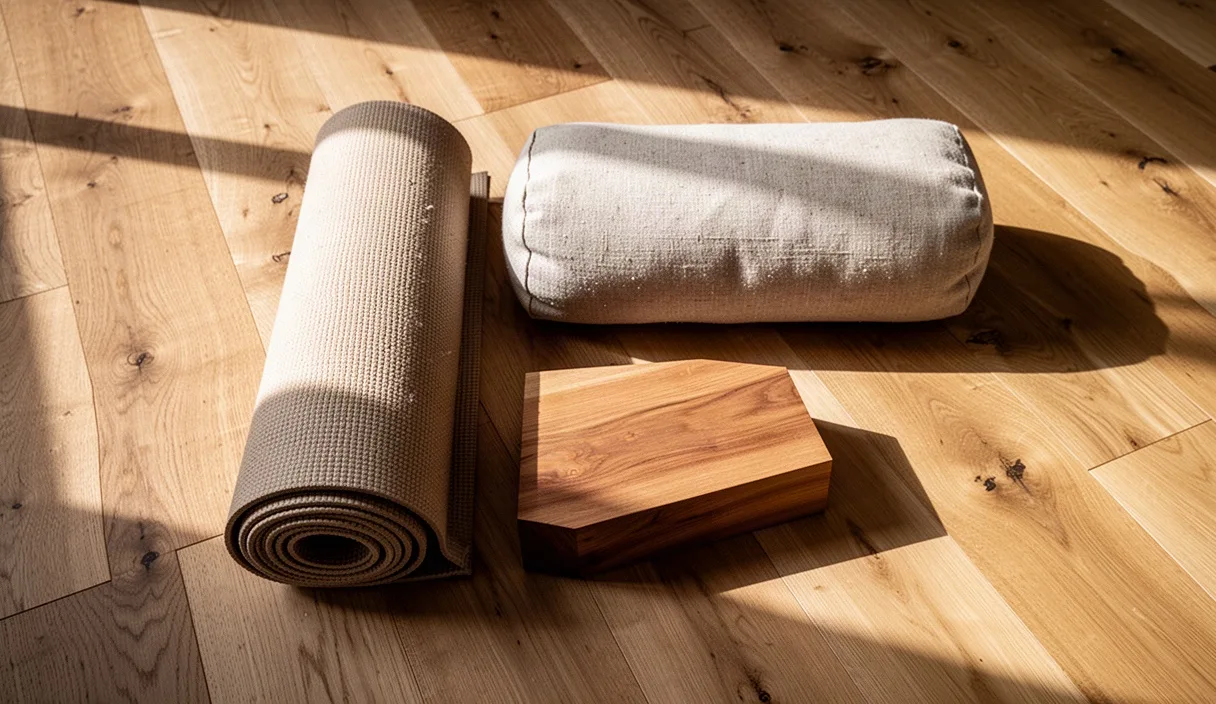
When fascial sheets around the sacrum, piriformis, and obturator internus become dense and dehydrated, passive positioning works better than active stretching. We turn to a firm bolster, packed with dense cotton batting or buckwheat hulls rather than soft synthetic foam. A yielding surface collapses beneath your weight, while a firm, ungiving tool offers clear sensory feedback that allows the nervous system to let go of guarding.
Position the bolster flat on the floor. Lower yourself down so that your sacrum, the flat triangular bone at the base of your spine, rests directly across the apex of the roll. Your lower back should hang in gentle traction, completely free from the bolster, while your shoulders and the back of your head remain anchored to the floor. Your knees stay bent, feet wide on the mat, knees allowed to fall together inward in an internal rotation rest.
Remain in this passive inversion for four to six minutes. Gravity naturally draws the abdominal organs toward the ribcage, removing visceral weight from the pelvic bowl. In this unloaded state, the pelvic floor muscles have the physical space to drop out of their habitual spasm. If you experience tingling down the back of your legs or numbness in the groin, roll off the prop immediately; nerve tissue must never be compressed or stretched aggressively.
To deepen this mobilization without straining, gently walk your feet toward each other, press the soles together, and let the knees fall open into a supported butterfly shape, keeping the outer edges of the feet grounded. In this position, the adductor attachments on the pubic ramus lengthen. Breathe into the groin for eight slow cycles, then bring the knees back together before sliding the bolster out from beneath your hips.
Establishing an Unwinding Habit at Your Desk
Most pelvic tension is not built during thirty minutes of exercise; it is forged across eight hours of static sitting. When we lean forward toward a display, we often tilt the pelvis into an anterior pitch, compressing the sacrum, or we slump back onto the tailbone, jamming the coccyx inward. Both positions lock the pelvic sling in a contracted holding pattern. Building an unwinding habit requires tactile cues throughout the working day.
Start with your seat base. A seat that is too soft encourages slouching, while a bucket seat tilts the knees higher than the hips, trapping the hip flexors in a chronically shortened state. Choose a firm, flat chair. Adjust the height so that your hip joints sit roughly two inches higher than your knee joints. This slight decline opens the femoroacetabular angle and lets the pelvis rest in a neutral upright balance, balanced directly on top of the ischial tuberosities, the sit bones.
- The Hourly Sit-Bone Check: Set an unobtrusive chime or silent timer for the fifty-minute mark of every working hour. When it signals, slide your hands beneath your buttocks to feel the two bony points of your pelvis. Rock slightly forward until you feel your weight rest directly on their center points, neither tucked behind them nor perched forward on the thighs.
- The Soft Palate Release: While sitting on your centered sit bones, touch the tip of your tongue to the roof of your mouth behind your front teeth, then let it drop to the floor of your mouth. Unclamp your jaw until your lips remain softly closed while your upper and lower teeth sit apart. Feel the corresponding release in your lower pelvis.
- The Three-Breath Drop: Take three deep nasal breaths down into the surface of your chair. On each exhale, actively soften the muscles around your anus and urethra, as if you are letting a tightly held fist slowly open its fingers.
- The Standing Hip Hinge: Stand up from the desk, place your feet wider than shoulder-width with toes pointing straight ahead, hands on your hips. Push your hips back behind you while keeping your spine long, letting your torso fold forward forty-five degrees. This lengthens the hamstrings and widens the sit bones under body weight. Hold for three slow breaths before returning to work.
Common Mistakes to Avoid
When addressing pelvic discomfort, good intentions coupled with the wrong tools often aggravate the tissue. We routinely see three errors that derail progress and prolong muscular bracing.
First, performing reflexive Kegels. If your pelvic floor is tight, painful, or hypertonic, performing voluntary upward contractions will deepen the muscular dysfunction. Do not attempt strengthening protocols until a clear baseline of relaxation and full excursion has been reestablished.
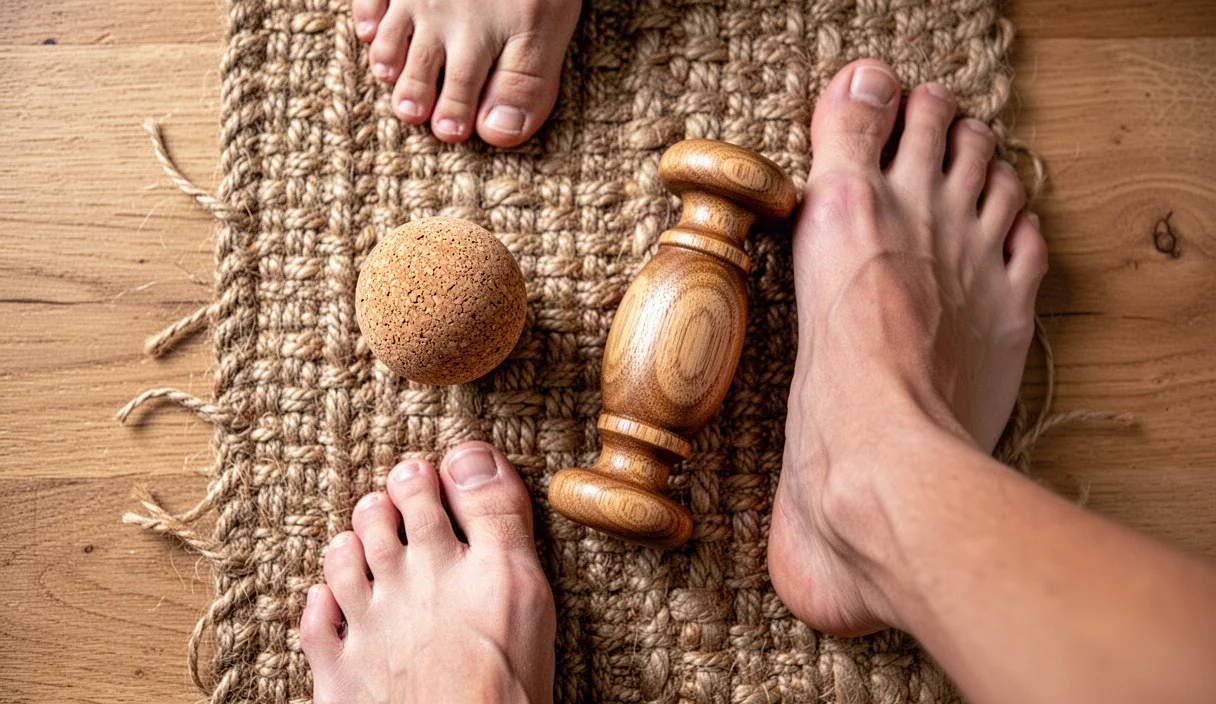
Second, using hard, pinpoint tools like lacrosse balls or hard massage spheres directly on the perineum or inner sit bones. The pelvic basin is dense with sensitive neurovascular bundles, including the pudendal nerve and artery. Crushing these structures against pelvic bone with hard rubber triggers protective muscle spasms and can cause nerve inflammation. Keep your tools broad, firm, and supportive, like blankets, rolled towels, or broad bolsters.
Third, holding the abdominal wall flat out of habit. Many of us unconsciously brace our transversus abdominis and rectus abdominis all day to maintain a flat stomach. This chronic bracing acts like a tight corset, forcing pressure down directly into the pelvic floor. You cannot have a relaxed, supple pelvic base if your belly is not allowed to move naturally with your breath.
Practical Next Steps for Daily Care
Restoring balance to muscular tissue requires consistent, quiet rhythm rather than occasional heroic efforts. Integrate these practices deliberately over the coming weeks, observing how your body responds to the reduction of physical bracing.
Begin tomorrow morning with five minutes of diaphragmatic breathing lying flat on your mat before getting dressed. Pay close attention to the descent of the pelvic floor as the ribs widen. Throughout the workday, observe your jaw. Every time you notice your teeth touching during typing or reading, let the jaw slacken and notice the instantaneous drop between your hips.
In the evening, spend five minutes over the firm bolster to unload the sacrum after hours of gravity and locomotion. Treat this time as a mechanical reset, letting the tissues yield at their own pace.
If you experience sharp pain, pain during intercourse, urinary incontinence that does not shift, or persistent coccyx pain after two weeks of consistent unwinding practices, arrange an evaluation with a licensed pelvic health physical therapist. They can map the specific bands of restriction within your pelvic architecture and provide precise manual release techniques that return your body to smooth, easy function.